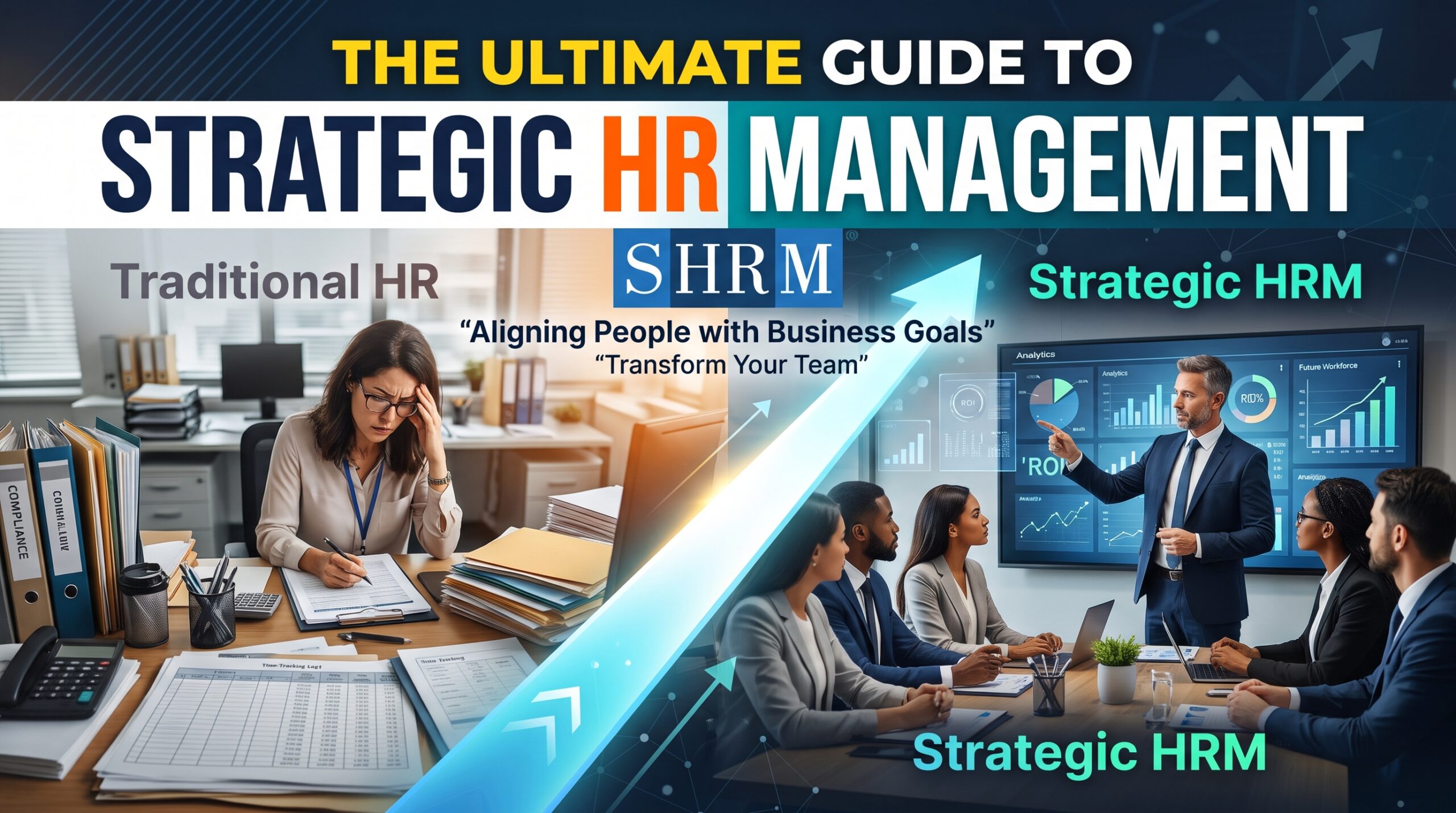
Strategic Human Resource Management (SHRM) is the practice of aligning an organization’s people policies, talent programs, and workforce planning directly with its long-term business goals. Rather than treating human resources as an administrative support function, SHRM transforms HR into a core driver of revenue growth, innovation, and competitive advantage.
When executed well, SHRM ensures that every hiring decision, training dollar, and compensation structure serves a clear business purpose—bridging the gap between daily employee management and high-level corporate strategy.
Strategic HRM vs. Traditional HR Management
Traditional HR and Strategic HRM are not mutually exclusive; rather, SHRM builds upon a strong operational foundation. You cannot execute a three-year talent strategy if payroll and compliance are failing. However, while traditional HR often spends up to 80% of its bandwidth on reactive administration, SHRM automates routine tasks so leaders can focus on high-impact initiatives.
| Dimension | Traditional HR Management | Strategic Human Resource Management (SHRM) |
| Primary Role | Administrative support and compliance (Cost Center) | Proactive business partner (Value Driver) |
| Time Horizon | Short-term, day-to-day operations | Long-term, 1-to-5-year organizational growth |
| Core Focus | Payroll, benefits administration, and policy enforcement | Workforce capability, organizational agility, and culture |
| Approach to Issues | Reactive (responding to turnover spikes or complaints) | Predictive (using data to spot talent risks early) |
| Key Metrics | Time-to-fill, headcount, and basic turnover rates | Revenue per employee, quality of hire, and training ROI |
| Hiring Mindset | “How quickly can we fill this open role?” | “What skills do we need to execute our 3-year plan?” |
The 5 Core Pillars of SHRM
A comprehensive SHRM framework integrates five interconnected pillars, each calibrated to support specific business outcomes:
- Strategic Workforce Planning & Talent Acquisition: Moving beyond simple headcount forecasting, this pillar involves working backward from corporate objectives to map out future talent needs. It encompasses skills-gap analyses, succession planning for mission-critical roles, “build vs. buy” talent decisions, and contingency planning for economic shifts.
- Aligned Performance Management & Development: Individual goals must cascade directly from company objectives so every employee sees how their daily work impacts the bottom line. Learning and Development (L&D) budgets are directed toward building organizational capabilities that create a market edge—not just generic skill catalogs.
- Behavior-Driven Compensation & Rewards: Strategic compensation goes beyond matching market averages; it uses pay structures, incentives, and benefits to reinforce desired behaviors. For example, a company pursuing rapid innovation should reward calculated risk-taking, whereas a business focused on operational efficiency should incentivize process optimization and consistency.
- Intentional Culture & Employee Engagement: Rather than relying on surface-level perks, SHRM engineers workplace culture through leadership behaviors, autonomy, psychological safety, and transparent career pathways. Engagement initiatives are designed specifically to nurture the habits that drive business performance.
- People Analytics & Evidence-Based Decisions: SHRM replaces gut instinct with hard data. By tracking metrics that link talent investments to financial outcomes—such as training ROI, new-hire retention, and productivity trends—HR leaders can make persuasive, data-backed cases in the boardroom.
Why SHRM Matters: Key Organizational Benefits
Organizations that elevate HR from a back-office function to a strategic partner consistently outperform their peers across several key areas:
- Higher Workforce Productivity: Connecting individual accountability to clear business targets eliminates wasted effort and sharpens execution across teams.
- Lower Turnover & Stronger Retention: Proactive onboarding, clear growth trajectories, and competitive, purpose-built rewards keep top performers engaged and reduce costly attrition.
- Superior Return on L&D Spend: Training budgets yield measurable business returns because investments target verified capability gaps rather than guesswork.
- Enhanced Organizational Agility: Continuous workforce forecasting enables companies to pivot smoothly during market disruptions, product launches, or rapid scaling.
- Reduced Operational Overhead: Automating routine HR workflows frees up budget and staff capacity for high-value strategic initiatives.
How to Implement SHRM: A 6-Step Roadmap
Transitioning to a strategic HR model does not require an overnight overhaul. Follow this phased roadmap to build momentum sustainably:
- Audit Business Goals and Current Capabilities: Start in the boardroom, not the HR manual. Analyze the company’s 1-to-3-year revenue targets, expansion plans, and competitive strengths. Simultaneously, inventory your current workforce’s skills and identify where critical talent bottlenecks exist.
- Forecast Future Workforce Needs: Project the specific roles, headcount, and technical or leadership competencies required to hit future milestones. Compare this future-state blueprint against your current roster to pinpoint exact capability gaps.
- Evaluate Resource Requirements: Conduct an internal and external audit of the financial, physical, and human resources needed to close those gaps. Decide whether to upskill internal talent, invest in targeted recruitment campaigns, or bring in specialized external partners.
- Automate Routine Administration: You cannot do strategic work while buried in paperwork. Deploy modern Human Resource Information Systems (HRIS) to automate payroll, benefits enrollment, time tracking, and compliance reporting—reclaiming hours for strategic planning.
- Execute Targeted Talent Initiatives: Roll out your strategy through disciplined hiring, structured onboarding, targeted L&D programs, and continuous performance feedback. Secure executive sponsorship early and communicate transparently with employees so everyone understands how the changes benefit both the company and their careers.
- Measure, Reassess, and Pivot: Establish a scorecard of 5 to 8 strategic HR metrics and review them alongside financial performance data. Treat your SHRM plan as a living framework—revisiting and adjusting your recruiting, training, or retention tactics as market conditions evolve.
Common Implementation Challenges (and How to Overcome Them)
Even well-designed SHRM strategies encounter friction. Anticipating these three common roadblocks will keep your rollout on track:
- Securing Executive Buy-In: Leaders accustomed to viewing HR as a cost center may hesitate to fund strategic initiatives. Overcome this by launching small, high-visibility pilot programs—such as a targeted retention initiative in a high-turnover department—and presenting concrete ROI data to leadership.
- Closing Skill Gaps Within the HR Team: Strategic HRM demands proficiency in data analysis, financial literacy, and change management. Invest in upskilling your HR staff first so they have the business acumen required to advise senior leaders effectively.
- Overcoming Manager Resistance: Middle managers used to treating HR merely as policy enforcers may resist a more collaborative model. Frame SHRM around solving their biggest pain points—such as reducing team turnover or speeding up hiring—to turn skeptics into advocates.
Frequently Asked Questions
Can small businesses benefit from SHRM? Yes. A 50-person company does not need a dedicated people-analytics department to practice SHRM. Small businesses can apply these principles by tying every new hire directly to a growth milestone, automating basic payroll, and tracking three to five core metrics like quality of hire and employee retention.
How long does it take to transition to a strategic HR model? You can establish a foundational SHRM framework and launch initial pilot programs within 3 to 6 months. However, a comprehensive transformation—including full HRIS automation, integrated analytics, and cultural adoption—typically takes 12 to 24 months via a phased rollout.
What skills do modern HR professionals need most for SHRM? Beyond traditional employee relations and compliance knowledge, strategic HR leaders need strong business acumen, financial literacy (the ability to read a P&L statement), data interpretation skills, and expertise in organizational change management.